
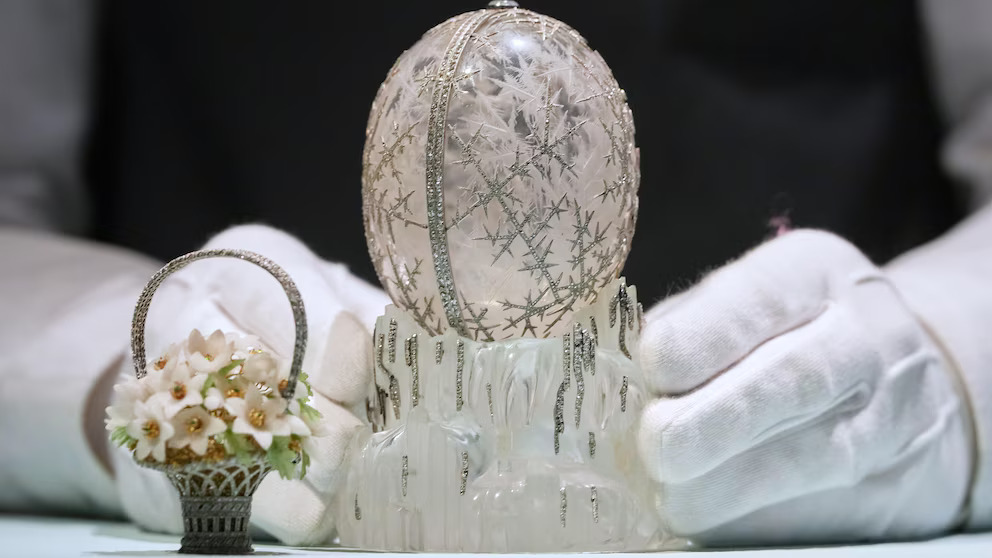
MOSCOW / LONDON – The global art and luxury goods market is currently scrambling to assess the impact of a new technological and philosophical controversy: the emergence of “Replicant Antiquities“—ultra-high-resolution, AI-designed, and 3D-printed recreations of lost historical treasures.
The debate centers on a new line of products from the mysterious Anglo-Russian luxury house, Tsarskoe Zelo, which recently unveiled the “Ekaterinburg Collection”: twelve stunning Fabergé-style eggs and other jewels. These pieces are not merely inspired by the famed imperial eggs, but are touted as “algorithmic reconstructions“ of twelve pieces lost or unaccounted for since the 1917 Russian Revolution.
🔍 The Technology: ‘Reverse-Engineering’ Art
Tsarskoe Zelo claims their process begins with scanning historical black-and-white photographs, auction records, and even microscopic dust samples taken from period storage boxes. They then feed this data into a proprietary Generative AI platform called “The Jeweler’s Ghost”.
“The Ghost doesn’t just copy. It learns the exact chisel pressure, the chemical composition of the enamel pigments, and the unique artistic ‘grammar’ of the original masters like Michael Perchin and Henrik Wigström,” explained Dr. Ania Karkoff, chief historical consultant for the project. “It essentially reverse-engineers the artist’s final creative intent.”
The final pieces are fabricated using a combination of nano-precision 3D-printing for the structural platinum and gold, and painstakingly hand-applied techniques by master jewelers for the enameling and gem-setting, ensuring a physical object identical in appearance and weight to the hypothetical original.
🏛️ The Great Authenticity Debate
The question now facing auction houses, museums, and collectors is: What is the value of an algorithmically-perfect copy of a lost original?
- The Traditionalists (Museums): Major institutions have balked, arguing that without the provenance—the history of ownership and creation—a piece is merely a high-end replica. They contend that the soul of the antique lies in the human history of its making, not just its physical form.
- The Technocrats (Collectors): A new wave of young, tech-forward collectors, however, see this as an opportunity. At a private auction last week, the first egg from the Ekaterinburg Collection, the “Tsarevich’s Journey,” sold for $4.5 million. Buyers are paying a premium for the story: a piece that is perfectly identical to a genuine artifact, created with a blend of historical data and cutting-edge AI.
- Legal Gray Area: Intellectual property lawyers are stumped. The original Fabergé designs are out of copyright, but the specific AI model’s output is a new, unique creation. Is the AI now the “artist” who deserves credit, or is it merely a sophisticated tool? The legal precedent will determine the future of digitally-reconstructed historical art.
For now, the Ekaterinburg Collection remains a spectacular curiosity, forcing the world to question if art’s most valuable asset is its history or its absolute aesthetic perfection.
 nddailyupdates.news.blog