
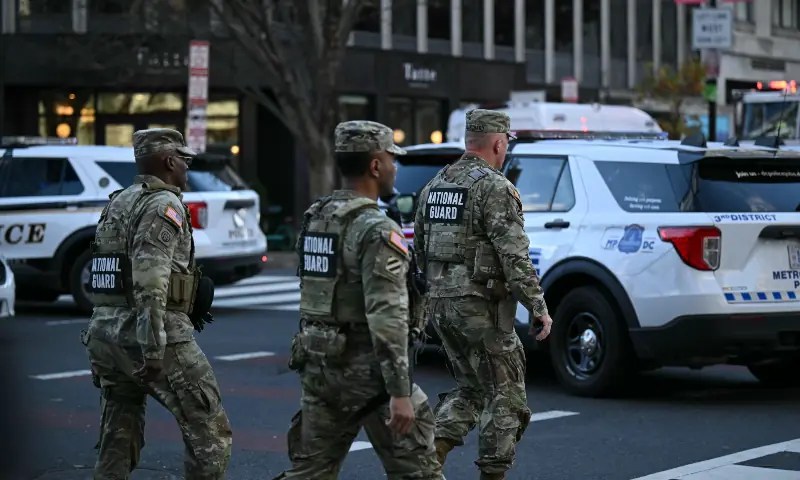
Washington, D.C. – November 28, 2025 – The brazen shooting of two National Guard soldiers near the White House on Wednesday, which has tragically resulted in the death of one service member, has immediately been classified by the FBI as an “act of terrorism.” The high-profile attack, carried out by an Afghan national with previous ties to a CIA-backed unit, has ignited a fierce national debate and drawn attention to a worrying global trend of persistent and evolving terrorist threats.
Specialist Sarah Beckstrom, 20, of the West Virginia National Guard, succumbed to her wounds late Thursday, according to President Donald Trump, while Staff Sergeant Andrew Wolfe, 24, remains in critical condition. The suspect, identified as 29-year-old Rahmanullah Lakanwal, who entered the U.S. in 2021 under a program for Afghans who assisted the U.S. military, was subdued at the scene and is currently in custody, facing murder and assault charges.
The Washington Attack: A Targeted Ambush
The shooting occurred on a busy street just blocks from the White House, with officials describing the incident as an unprovoked, “targeted ambush” on uniformed personnel. Law enforcement reports indicate Lakanwal drove across the country from Washington state with a manifesto-like document railing against “American imperialism.”
FBI Director Kash Patel and U.S. Attorney Jeanine Pirro confirmed the terrorism investigation is ongoing, focusing on the suspect’s motive and any potential links to domestic or international extremist groups.
Global Terrorism: Spreading and Evolving
The incident comes at a time when global security reports already signal a troubling resurgence and geographical spread of terrorism worldwide. The Global Terrorism Index (GTI) 2025, published earlier this year, highlights key concerns:
- Geographic Expansion: The number of countries experiencing at least one terrorist incident increased from 58 to 66 in the preceding year, reversing a decade of marginal improvements.
- The Rise of Lone-Wolf Actors: In Western nations, lone-wolf attacks now dominate, often driven by online radicalization that blends various extremist ideologies. This makes tracking and intervention exceedingly difficult for intelligence agencies.
- Conflict as a Catalyst: The Sahel region in Africa remains the global epicentre, and the war in Gaza has been cited as a catalyst for a sharp surge in antisemitic and Islamophobic hate crimes and related attacks in the U.S. and Europe.
- Resilience of Major Groups: Despite years of counterterrorism efforts, deadly organizations like the Islamic State (IS), including its prominent affiliate IS-Khorasan (ISK), and al-Shabaab continue to show resilience, with fatalities attributed to the four deadliest groups rising by 11%.
The Political Fallout and Security Review
President Trump, who was quick to condemn the attack as an “act of terror,” used the incident to call for an immediate halt to the processing of all immigration requests for Afghan nationals and ordered a re-examination of all Afghans resettled during the previous administration.
The National Guard shooting, particularly its connection to an individual previously vetted by U.S. agencies, raises complex and uncomfortable questions about the effectiveness of existing security protocols and the long-term domestic threats posed by ideological extremism.
In response to the tragedy, the Department of Defense has ordered the deployment of an additional 500 National Guard troops to Washington, D.C., underlining the gravity of the event and the immediate concern for the security of the nation’s capital.
What Happens Next? The terrorism investigation is now coast-to-coast, with federal agencies scouring the suspect’s digital and physical trail for co-conspirators or a definitive motive. The outcome of this high-profile case is likely to have significant implications for immigration policy and the ongoing debate surrounding domestic counter-terrorism strategies.
 nddailyupdates.news.blog