
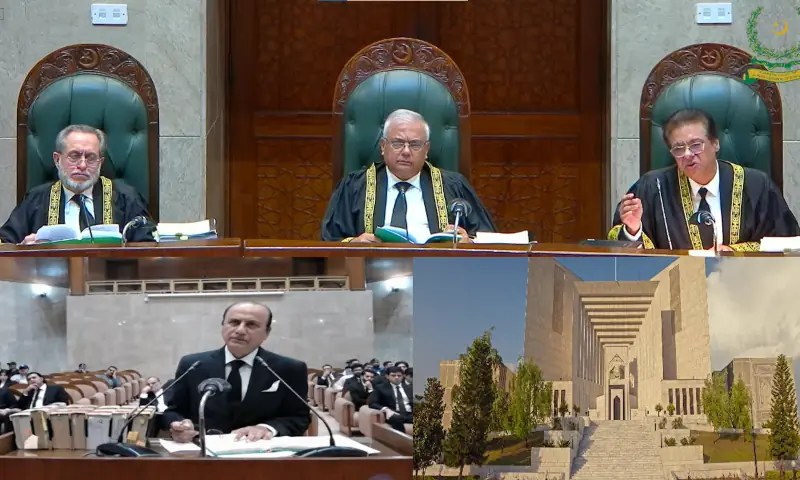
During the ongoing landmark proceedings challenging the Constitution (Twenty-sixth Amendment) Act, 2024, Supreme Court Justice Mazhar Alam Miankhel made a significant observation regarding the nature of the judiciary’s benches. “nddailyupdates” The remark came as the Constitutional Bench continued to hear arguments on the validity and impact of the amendment, which brought sweeping changes to judicial appointments and the structure of the superior courts.
Justice Miankhel is reported to have stated that the Supreme Court’s “regular benches” and the newly established “Constitutional Benches” are merely “branches of the same tree,” emphasizing the inherent unity of the superior judiciary despite the structural division introduced by the amendment.
Context of the Remark
The 26th Constitutional Amendment introduced several controversial provisions, including the creation of dedicated Constitutional Benches within the Supreme Court and High Courts. Critics of the amendment argue that this division, where Constitutional Benches are designated to exclusively hear matters involving the interpretation of the Constitution and the enforcement of fundamental rights, is a form of “court-managing” or “court-curbing.” They contend that this allows for the composition of benches to be tailored for specific, politically significant cases, potentially undermining judicial independence.
Justice Miankhel’s comment serves as a judicial counter-narrative, affirming that regardless of the new constitutional structure, the judges and benches remain part of a single, indivisible judicial institution. This highlights the internal debate within the judiciary over how to interpret and operate within the new legal framework.
Key Issues of the 26th Amendment Challenge
The petitions currently being heard challenge the very foundations of the 26th Amendment, which has introduced radical changes to the judicial system, including:
- Change in Chief Justice Selection: Discarding the rule of seniority and allowing a Special Parliamentary Committee to select the Chief Justice from among the three most senior judges.
- Altered Judicial Commission (JCP) Composition: Shifting the majority in the JCP—the body that nominates judges—from the judiciary to the executive and legislature, increasing political influence over appointments.
- Creation of Constitutional Benches: Mandating specific benches to hear constitutional matters, a key point of contention in the ongoing case.
- Limitation of Suo Motu Powers: Curtailing the Supreme Court’s power to take action on its own initiative to deliver complete justice.
The ongoing hearing, presided over by the Constitutional Bench itself (a body created by the amendment under challenge), is one of the most critical legal battles in recent Pakistani history, addressing fundamental questions about the separation of powers and the independence of the judiciary.
 nddailyupdates.news.blog